



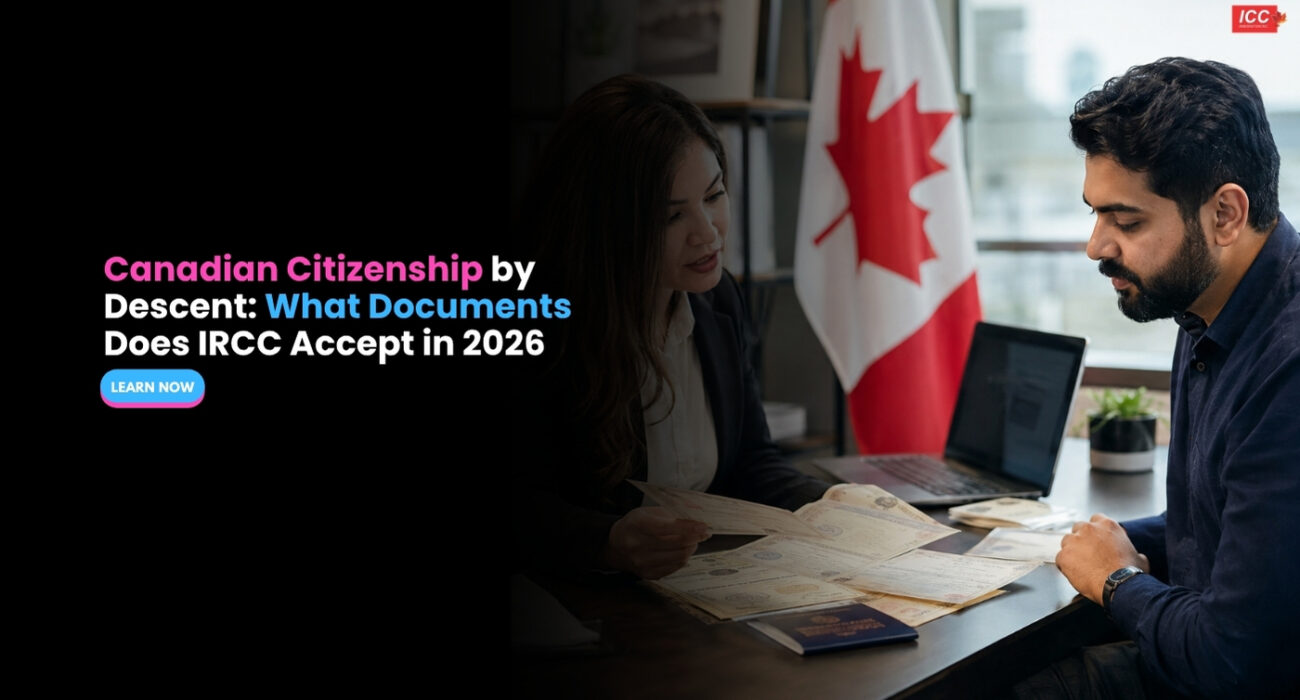
If you believe you may be a Canadian citizen by descent, having old family records can be a valuable starting point—but the type and source of your documents matter. Recent IRCC citizenship by descent guidance provides useful clarification on how documentary evidence is assessed, including situations where applicants have historical records that are not certified.
Canada’s citizenship rules also changed following Bill C-3, which took effect on December 15, 2025 and changed the previous first-generation limit in certain situations.
Do Canadian Citizenship Documents Have to Be Certified?
One of the most important points from recent guidance is that documents do not automatically have to be certified for a proof of citizenship application. However, an IRCC officer can request a certified copy if there are concerns about a document’s authenticity.
More importantly, IRCC emphasizes the original authority that created or maintains the record. For example, a civil registry, vital statistics authority or archive may be considered an appropriate source.
The source material reviewed for this article also notes that certification is not the first issue an officer considers. Instead, applicants should focus on whether their records are authentic, verifiable and connected through every generation.
Primary vs. Secondary Evidence for Citizenship by Descent
When preparing a Canadian citizenship certificate application, it is useful to distinguish between primary and secondary evidence.
Primary documents can include:
- Canadian provincial or territorial birth certificates
- Foreign birth certificates establishing parent-child relationships
- Canadian citizenship or naturalization certificates
- Registration of Birth Abroad or Retention certificates
- Certain historical British naturalization or British subject records
IRCC states that applicants should provide authentic, reliable and verifiable documents for each relevant generation. Records should come from the authority that created or maintains them.
Secondary documents may also help establish a family connection. Examples include baptismal records, hospital records, census information, marriage and death records, immigration records, military records, passports and boat manifests.
However, secondary evidence should not automatically be treated as a substitute for primary documentation when primary records are available.
What If a Family Record Is Missing?
Not every family has a complete paper trail. If a birth certificate or another important record cannot be obtained, IRCC says applicants should explain why the document is unavailable and demonstrate their efforts to obtain it. Evidence such as correspondence with the relevant authority may help establish that a genuine search was conducted.
This is particularly important when dealing with historical Canadian citizenship records.
The source material also highlights that a formal “No Record Found” letter may not always be required according to the stakeholder-session summary, although applicants should still document their attempts to locate missing records.
Canada Gazette Records Can Help in Some Cases
For certain historical cases, Canada Gazette naturalization records may provide useful supporting evidence. The reviewed IRCC presentation indicates that names of naturalized Canadians were published in the Canada Gazette up to 1952.
These records can be particularly useful when an ancestor’s original naturalization documentation is difficult to locate. However, they are considered supporting evidence rather than a universal replacement for primary records.
How IRCC Assesses Citizenship by Descent Claims
IRCC considers the complete collection of information submitted with an application. The reviewed guidance states that citizenship-by-descent claims are assessed on a balance of probabilities—essentially, whether the evidence makes the claim more likely than not.
This makes consistency extremely important.
For example, differences in names, dates of birth or family relationships across generations should be investigated and, where possible, supported with additional documentation or an explanation.
The current CIT 0014 citizenship certificate document checklist was updated in June 2026, so applicants should always check the latest IRCC requirements before submitting an application.
How ICC Immigration Can Help
Understanding Canadian immigration pathways and citizenship documentation can be complicated, particularly when family records are old, incomplete or inconsistent.
ICC Immigration can help clients assess their circumstances and identify an appropriate immigration or citizenship strategy.
Our services include:
- Permanent Residency Applications: Assistance with Express Entry, Provincial Nominee Programs (PNPs) and other Canadian PR pathways.
- Work Permits and Study Permits: Guidance for people looking to study or work in Canada and potentially build toward Canadian permanent residency.
- Family Sponsorship: Support for eligible applicants seeking to reunite with family members in Canada.
- Immigration and Citizenship Guidance: Professional assistance with documentation, eligibility and application requirements.
Rather than relying on an uncertain immigration strategy, applicants should explore the pathway that actually fits their circumstances. Whether you are already in Canada or planning your immigration to Canada, proper preparation can help you make informed decisions.
Your Canadian future starts with understanding your options. Contact ICC Immigration to discuss your circumstances and explore the appropriate pathway.